Black Friday 2026 Results: A $13.1 Billion Record and Five Acquisition Lessons Beyond AI
Black Friday 2026 closed with $13.1 billion in U.S. online sales (+11.1%). Beyond AI, Adobe and Salesforce data show the weight of value, social media, affiliates, mobile and 30% bot traffic. Five acquisition lessons to apply before Cyber Monday.
 BySebastián RondónCEO y fundador de KMS Agency Group
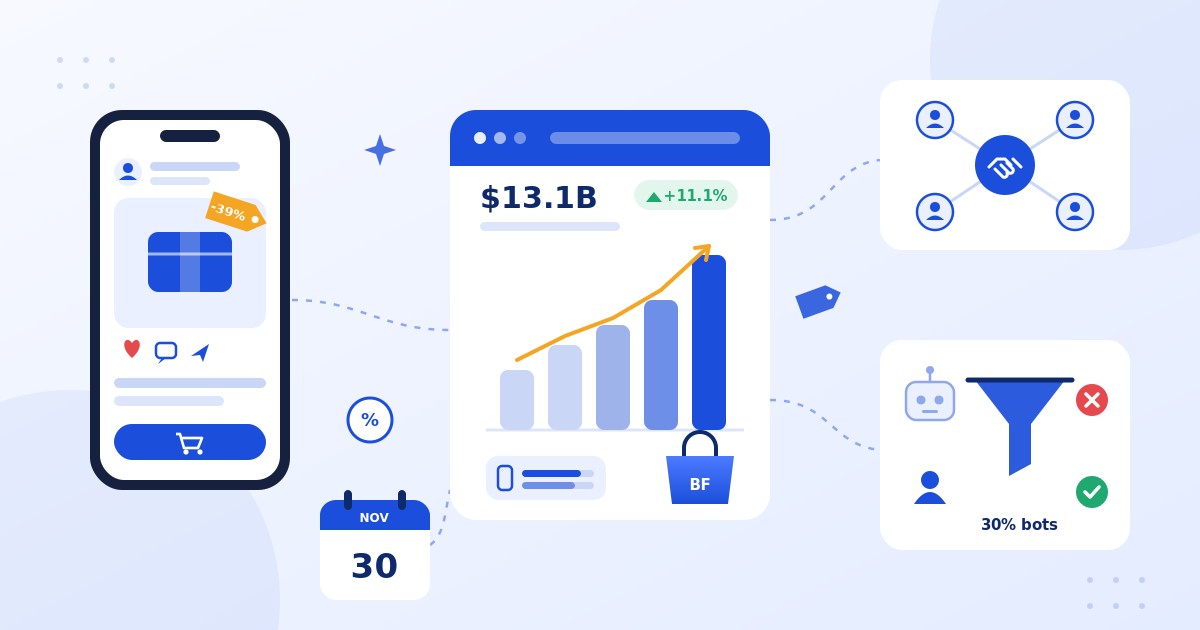
Black Friday 2026 closed with a record. According to Adobe Analytics, U.S. consumers spent $13.1 billion online on Friday, November 27, up 11.1% year over year and above the $12.9 billion Adobe itself had forecast. Much of this week's conversation has focused on artificial intelligence, but when you look at all the data published between Thursday and this Saturday, the story is broader: the record is also explained by value, social media, affiliates, mobile and a volume of non-human traffic that few brands are filtering out.
At KMS Agency, we went through the Adobe and Salesforce figures to keep what matters for any marketing and sales team, whether or not it sells in the United States: where demand is being won and what to adjust before Cyber Monday and year-end.
What the Black Friday 2026 results show
A record driven by value
Reuters reported on November 28 that online spending rose 11% to $13.1 billion, with strength in toys, electronics, gaming and AI-powered gadgets. But the same Adobe report highlights another behavior: shoppers used discounts to stock up on everyday essentials such as cleaning supplies, pet care and personal hygiene products. All of this with inflation running at 3.8%.
Adobe sums up the season in one idea: consumers are looking for value, and that is driving ecommerce to $1 of every $4 spent on retail goods this holiday season. Meanwhile, U.S. store foot traffic fell 2.2% year over year on Black Friday, to nearly 930 million visits, according to geospatial analytics firm PassBy, as cited by Reuters.
The weekend is not over yet
Adobe expects $15.1 billion in online sales on Cyber Monday (+6.2%), which would be the first single day to top $15 billion in the U.S., and about $47.5 billion over the five days from Thanksgiving to Cyber Monday. Buy now, pay later (BNPL) alone is expected to contribute $1.09 billion on Monday, up 5.3%.
Five acquisition lessons that go beyond AI
1. Social media sells, but it sells at a discount
According to Salesforce, social traffic hit an all-time high on Thanksgiving: it rose 18% year over year to account for 23% of global ecommerce traffic, and 24% in the U.S. In its November 19 forecast, the company had already reported that the share of orders from social media referrals grew 27% year over year across October and November.
The key nuance: purchases coming from a social media referral carried an average discount rate of 39%, 18% higher than the U.S. average for all transactions. Social drives volume, but it attracts a highly price-sensitive buyer.
What to do: measure margin by channel, not just cost per acquisition. A social campaign that sells a lot at a deep discount can leave less profit than one with fewer orders and a better price.
2. Affiliates and social gain ground; organic search loses it
Adobe notes that between January 1 and October 31, 2026, affiliates and partners, together with social networks, posted the strongest growth in revenue share. Paid search saw modest gains and natural search declined. Adobe describes it as a clear shift toward partner- and social-led acquisition.
What to do: if all of your brand's demand depends on SEO or a single ad platform, it is time to diversify. An affiliate program, creator partnerships or deals with business partners are no longer add-ons: they are among the fastest-growing channels.
3. Mobile brings the traffic, but not always the order
Salesforce reported that mobile devices drove 82% of all global ecommerce traffic on Thanksgiving and 73% of orders. That nine-point gap is a clue: some people who arrive on their phone do not finish the purchase there.
What to do: review the mobile funnel step by step: load speed, forms, payment methods and financing options. If your buyers like to pay in installments, that option should be visible before checkout, not at the very end.
4. Almost a third of traffic was not human
This is the figure that got the fewest headlines and the one that affects marketing teams the most: according to Salesforce, 30% of Thanksgiving Day ecommerce traffic came from bots and crawlers. In its forecast, the company had estimated that 20% of holiday traffic would be non-human.
What to do: before drawing conclusions about conversion rate, bounce rate or cost per visit, separate human traffic from automated traffic. A spike in visits that does not buy may not be a page problem, but a source problem. It also pays to exclude that traffic from retargeting audiences, so you are not paying to chase a bot.
5. AI converts better, but it is one piece of the system
AI does show up in the data. According to final Adobe figures released this Saturday and reported by CMSWire, visits from AI tools converted 68% better than non-AI traffic. We already covered that trend in depth in our article on AI-referred traffic during Thanksgiving.
What we add today is proportion: CMSWire points out that Adobe does not disclose what share of total traffic comes from AI, and that a large conversion advantage on a small channel can move less revenue than a smaller gain on paid search or social. AI is a piece to prepare for, not a replacement for a complete acquisition strategy.
What these numbers don't tell you
These figures deserve a critical read. They are U.S. data for a very specific period. Several are preliminary: Salesforce's Thanksgiving data reflects a 9 a.m. ET cut on Friday, and the Cyber Monday figures are still projections. They also come from companies that sell analytics, commerce and agent platforms, as CMSWire also notes.
Even so, the trends are consistent across sources: consumers compare more, buy on their phones and discover on social.
What to do before Cyber Monday and year-end
1. Measure margin by channel, not just sales and CPA. 2. Filter bot traffic out of your analytics and audiences. 3. Test your mobile checkout with a real order from start to finish. 4. Build a second acquisition engine: affiliates, creators or partners. 5. Communicate value, not just discounts: shipping, warranty, financing and clear benefits.
Conclusion
The Black Friday 2026 results show consumers who kept buying, but who demand more value and arrive through different paths than two years ago. AI is part of that shift, but not the only part: social media, affiliates, mobile and automated traffic are redefining how a sale is measured and how it is won.
At KMS Agency, we help companies build that complete system: campaigns, clean measurement and funnels that convert. If you want to review how your demand arrived this season and what to adjust for 2027, explore our digital advertising service and let's talk.
Sources and further reading
- US Black Friday online spend rises 11% to a new high of $13.1 billionReuters (vía StreetInsider) · 2026-11-28
- 2026 Holiday Shopping Trends, Statistics & ActualsAdobe Digital Insights · 2026-11-28
- Agents Spent More Per Thanksgiving Order Than Human ShoppersMediaPost · 2026-11-27
- Record Cyber Week Expected to Deliver $75.8B in AI-Driven SalesSalesforce · 2026-11-19
- Who Won Black Friday Conversions? AI in a LandslideCMSWire · 2026-11-28