Healthcare Voice AI Is Moving From Answering Calls to Doing the Work
Innovaccer has brought Grok Voice into its healthcare voice agents, now handling more than five million patient interactions. The lesson for clinics and practices: a voice agent is worth the tasks it finishes, not how natural it sounds.
 BySebastián RondónCEO y fundador de KMS Agency Group
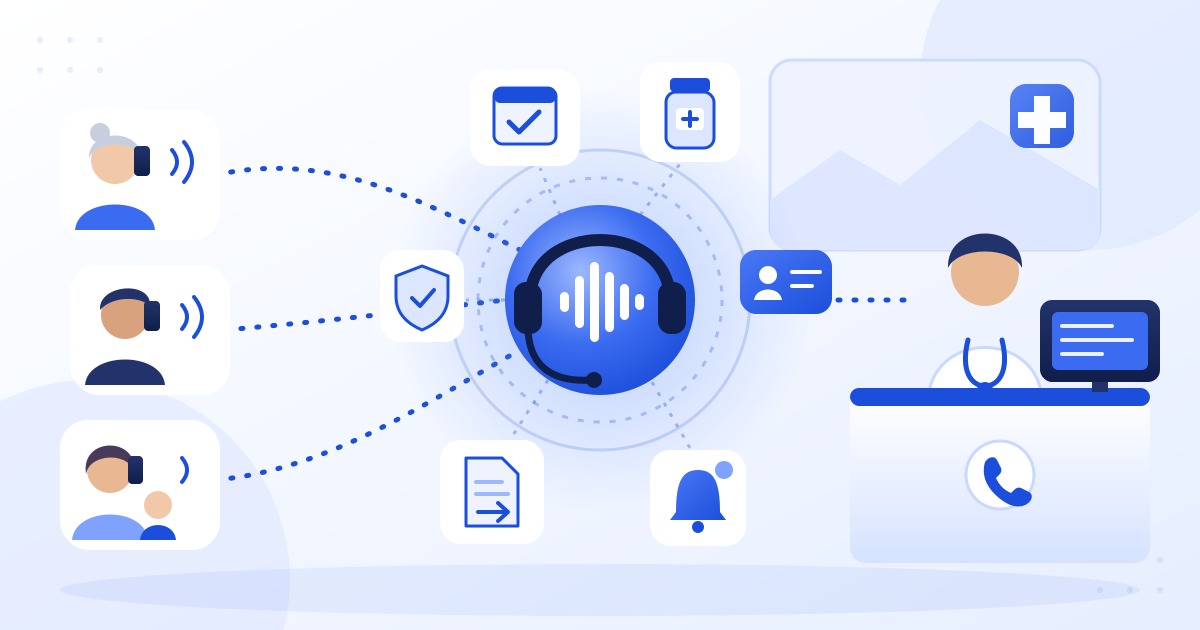
When someone calls a clinic, they are rarely asking for a diagnosis. They want to book an appointment, move it, get a prescription refilled, understand a bill or find out where to go next. These calls are short and repetitive, and they pile up: the front desk gets swamped, staff burn out and patients wait on hold.
That is the problem behind an announcement Innovaccer, a US healthcare operations platform, made today, November 23, 2026. The company has integrated Grok Voice, SpaceXSI's speech-to-speech model, into its Gravity Voice AI agents. The line that best sums up the news came from co-founder and CEO Abhinav Shashank: "Healthcare Voice AI is moving from answering questions to doing work."
At KMS Agency, we think that sentence is the right lens for any clinic, practice or medical group evaluating a voice agent right now.
What Innovaccer announced
Based on the official press release and coverage by Fierce Healthcare and SiliconANGLE, here are the essentials:
- Available now. Gravity Voice AI agents with Grok Voice are live, starting with upgrades for existing customers and new deployments.
- A model built for the phone. Innovaccer describes Grok Voice as full speech-to-speech, with sub-second time to first audio, native tool use, reasoning while it speaks, 25+ languages and training on real phone audio: interruptions, corrections, background noise and the messy way people actually talk.
- Volume growth. In the six months since its voice deployments went live, patient voice interactions grew from roughly 250,000 to more than five million. The company says customers are booking "significantly more" appointments, have tripled referral intake and cut documentation time per case by 90%.
- Concrete use cases. Scheduling and rescheduling, referrals, prior authorizations, cancellations and routing; refill requests, reminders, intake and follow-up; chronic care check-ins and post-discharge follow-ups; and care gap outreach such as annual wellness visits and preventive screening reminders.
- A human in the loop. For administrative conversations like scheduling and refills, software should handle the large majority of volume. In clinical conversations, a human stays in the loop.
A word of caution on the numbers: they are self-reported and cover Innovaccer's voice platform overall, not a published before-and-after comparison of the new model. Still, the direction is unmistakable.
The real lesson: a voice agent is worth what it finishes, not how well it talks
The most useful part of the release is a point Innovaccer makes almost in passing: a capable voice model is not enough. What turns it into an agent that finishes a task rather than handing it to a person is everything underneath: a unified patient record, orchestration across connected systems and deep clinical and operational workflows.
For a mid-sized clinic, that translates into something very practical. If the agent sounds great but a receptionist still has to call the patient back to confirm the slot, because the agent never had access to the live schedule, nothing was really automated.
Administrative calls come first
Most of a health organization's phone traffic is administrative, which makes it the natural starting point:
1. Booking, confirming, rescheduling and canceling directly in the live schedule. 2. Reminders and confirmations ahead of the visit to reduce no-shows. 3. Refill requests, capturing the details and routing them to the provider who must approve them. 4. Operational FAQs: opening hours, locations, test preparation, documents to bring. 5. Proactive outreach to patients with overdue check-ups or open care gaps.
Clinical conversations stay with people
The same announcement draws the line clearly. That boundary is a design decision, not a technical footnote. A good healthcare voice agent has to recognize when a call stops being administrative and transfer it quickly, with the context already captured, so the patient never has to repeat their story.
Five questions to ask before deploying healthcare voice AI agents
When a clinic or a multi-site group asks us about a voice agent, these are the questions we put on the table.
1. Does it connect to your real systems?
If the agent cannot read and write to the schedule, the EHR or the practice management software you already use, it is not resolving anything. It is taking messages. Integration is the difference between a polished answering machine and an agent that does work.
2. Does it understand how patients actually talk?
Innovaccer highlights training on real phone audio, with interruptions and noise. In practice that means accents, calls from the street and older patients who speak slowly. Test the agent against real call scenarios before you switch the line over.
3. Are the escalation rules explicit?
Define what the agent handles alone, what goes to the front desk and what goes to a clinician, and how fast. Emergencies should never stay in a conversation with an AI.
4. How is patient data protected?
The announcement notes that Grok Voice is HIPAA-eligible, with a business associate agreement available. Outside the US, every country has its own rules on personal and health data, and the agent's design must respect them: what it asks for, where recordings are stored and who can access them.
5. Which metric will you track?
Calls answered is not enough. What matters is how many requests were resolved on the same call: appointments booked, confirmations obtained, refills logged, patients brought back. That is the number that shows whether the agent is actually doing the work.
For a broader view of what AI agents can do in this space, see our guide to AI agents for clinics and medical practices. And to understand the mechanics of an AI-handled call, read how AI calling agents work.
What this means for clinics outside large US health systems
Innovaccer operates at the scale of the US healthcare system. But the problem it targets looks the same in a mid-sized clinic in Latin America or a medical group in Europe: phones that never stop ringing, an overloaded front desk, patients who cannot get through and appointments that slip away.
You no longer need to be a large hospital to deploy a voice agent. What you do need is the right scope from day one: a handful of administrative tasks properly connected to your systems, clear handoff rules to humans and a resolution metric. Then you expand.
Conclusion
Today's news is not just that a more advanced voice model has reached healthcare. It confirms a shift in how voice agents are judged: by the tasks they complete, not by how natural they sound. Booking, confirming, reminding and following up are real work that a well-designed agent can take on, while clinical conversations stay with professionals.
At KMS Voice AI, the voice agent line of KMS Agency, we build agents that answer and place calls connected to each business's schedule and systems, with escalation rules and human oversight. If you want to see what that could look like for your clinic, explore how we work with AI or get in touch at kms-agency.com.
Sources and further reading
- Innovaccer Expands Gravity Voice AI with Grok Voice for Autonomous Patient EngagementInnovaccer (comunicado oficial) · 2026-11-23
- Innovaccer integrates Grok Voice into Gravity Voice AI agentsFierce Healthcare · 2026-11-23
- Innovaccer expands Gravity Voice AI agents with SpaceXSI's Grok Voice modelSiliconANGLE · 2026-11-23