T-Mobile Gave Its AI Agent All the Data, and Customer Service Got Worse
T-Mobile loaded its entire support library into a single AI agent and got wrong answers. What worked was simpler: narrow context and specialized agents. What it means for your customer service and how to apply it.
 BySebastián RondónCEO y fundador de KMS Agency Group
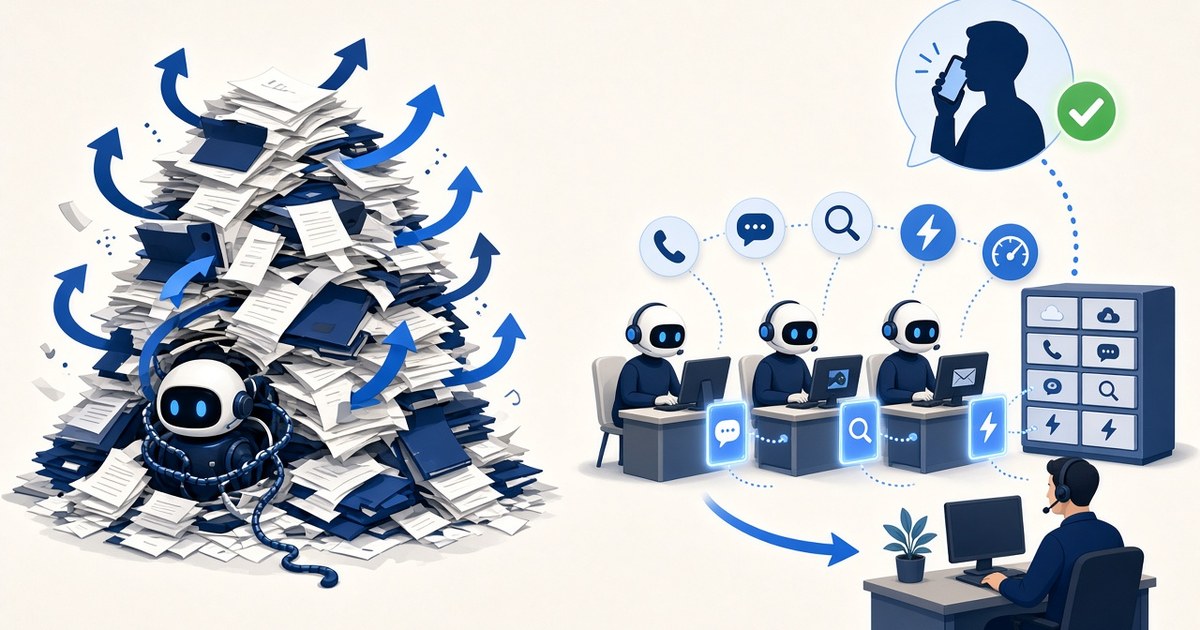
When a company decides to put an AI agent in front of its customers, the first instinct is almost always the same: "let's give it everything." Every manual, every policy, every FAQ, the full history. If the agent knows everything, the thinking goes, it will answer better.
T-Mobile, one of the largest wireless carriers in the United States, tried exactly that. It backfired. CIO Jeff Simon walked through the story at a VentureBeat summit in San Francisco, and the account published on November 21 by The SaaS Sentinel carries a lesson we see every day with our clients at KMS Agency: an AI agent doesn't get better by knowing more. It gets better by knowing exactly what it needs for each conversation.
What went wrong at T-Mobile
The first attempt looked sensible. Engineers loaded the entire customer support documentation library into a single agent, taking advantage of models with very large context windows. The goal was one expert that knew it all.
Instead, the agent started giving wrong answers. As Simon put it, when you load up the context window, the AI is forced to choose between paths in the documentation and may answer from the wrong one. After weeks of digging, the team found the root cause: the documentation itself contained conflicting instructions. The agent wasn't broken. It simply had no way to tell which version was right.
The second attempt was a knowledge graph. That works in other settings, but T-Mobile's agents handle live calls, and searching a graph that large took time a phone call doesn't have.
The fix that worked was, in Simon's own words, "very basic": a key-value cache built around how customers actually phrase their questions, plus a shift from one generalist agent to several specialized AI agents, each with the narrowest possible context. According to the same report, AI now handles 40% of T-Mobile's customer contacts, human-handled calls are already down 55%, and the company is aiming for a 75% reduction by the end of 2027.
Not an isolated case
The article also cites an October 2026 VentureBeat survey of 97 organizations running AI agents on company data: 78% traced at least one confident but wrong answer to missing or inconsistent business context in the previous six months. Only 10% said loading large inputs straight into the model was their main source of context.
On the customer side, getting it wrong is expensive. A CMSWire survey of 1,040 U.S. consumers, commissioned by Zingtree, found that:
- 68% would abandon AI support after two failures or fewer.
- 50% got generic, unhelpful AI answers on their most recent complex issue.
- 50% had to repeat information to a human after being transferred from AI.
- 64% trust AI more when they control when to reach a human agent.
Put simply, customers give AI two chances. An agent that "knows everything" but answers from the wrong document burns through both of them fast.
Three takeaways for your business
1. Clean up your knowledge before you feed the agent
T-Mobile's real problem wasn't the model; it was contradictory documentation. Most companies have the same issue: a 2023 returns policy sitting next to the 2025 one, outdated prices in a forgotten PDF, two versions of the same procedure. An experienced employee knows which one to ignore. An AI agent doesn't. That's why, at KMS Agency, every deployment starts by cleaning and versioning the information the agent will use, not by plugging in everything that exists.
2. Specialized agents beat one agent that does it all
One agent for billing, one for bookings, one for technical support, and a routing layer that sends each conversation to the right one. Each with a small, clear, consistent context. It's less flashy than a "super agent," but it's faster, easier to audit and, above all, more accurate. When something goes wrong, you know exactly which agent and which piece of information to check.
3. Speed is part of accuracy, especially on voice
On a call, a long pause feels like a mistake. That's why T-Mobile dropped a technically sophisticated architecture that couldn't answer in time. For voice agents, good design prioritizes fast answers to the questions customers really ask and leaves the complex cases for a well-executed handoff.
The human handoff is part of the design, not a fallback
Zingtree's numbers are clear: trust goes up when customers know they can reach a person, and it drops when they have to repeat everything after a transfer. A good AI agent doesn't try to solve everything. It recognizes when it can't and hands the conversation over with full context, so your team can pick up without starting from scratch. We covered this in our piece on human approval for AI agents: AI amplifies your team, but judgment stays human.
How we apply it at KMS Agency
When we design an AI agent for customer service, on WhatsApp, web chat or voice, we work from a short list of principles:
- Inventory and clean the knowledge before the first test: one source of truth per topic.
- Agents by function, with clear rules and limits on what each one can answer.
- Real questions first: we start from how your customers ask, not from how your manual is organized.
- Handoff with context to your team when the case calls for it, so nobody has to repeat their story.
- Measure resolution, not containment: what matters is whether the customer's issue got solved, not how many conversations the AI "kept."
To go deeper into how an agent's knowledge should be structured, see our guide to internal knowledge bases with RAG.
Conclusion
T-Mobile's experience debunks a popular belief: that AI improves simply with more data. In customer service, the opposite is often true. An agent fed every document the company owns, unfiltered, gets confused. One that gets the right context at the right moment resolves. The difference isn't the model you pick; it's the judgment behind what the agent knows, what it's allowed to do and when it should pass the conversation to a person.
That's what we do at KMS Agent AI: design AI agents that serve your customers with accurate, fast answers, under your rules. Curious how it would look in your operation? See how we build AI agents.