Turn Detection in Voice Agents: AI No Longer Just Has to Sound Human, It Has to Know When to Speak
AWS, Twilio and Microsoft all put the same problem at the center of their November launches: knowing when a caller has finished speaking. What they announced, the numbers they shared and five steps to stop your voice agent from interrupting.
 BySebastián RondónCEO y fundador de KMS Agency Group
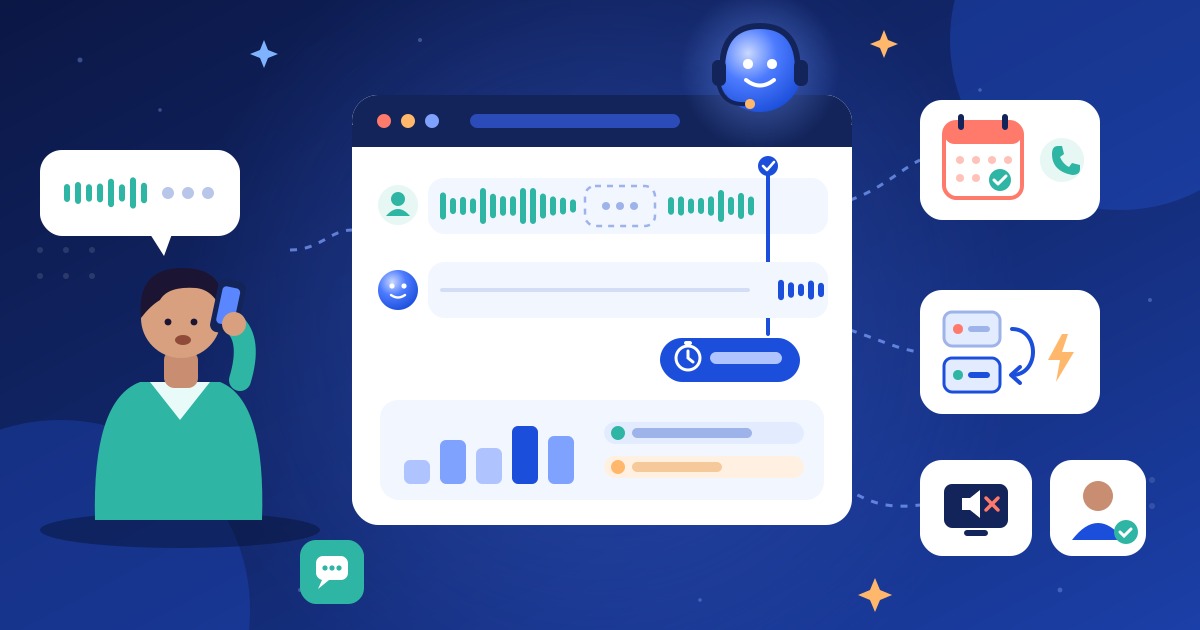
Anyone who has tested a voice agent knows the moment. A caller says "I'd like to move my appointment to…", pauses to remember the date, and the agent is already answering something else. Or the opposite: the caller says "yes" and sits through an awkward silence before the agent reacts. Neither is a model intelligence problem. It is a turn detection problem: knowing when the person has actually finished speaking.
Over the past two weeks, three of the biggest voice infrastructure providers put that exact problem at the center of their announcements. At KMS Agency, we read it as a clear signal: the conversation itself, not just the language model, is now what separates a demo voice agent from one that holds up in production.
What AWS announced on November 25
On November 25, 2026, AWS released Amazon Transcribe Turbo in public preview, its next-generation speech-to-text model, currently available in the US East (Ohio) region. According to the announcement:
- Streaming supports English, Portuguese, French, Italian, German and Spanish. Word error rate drops by about 14% relative in English and 11% relative in the other languages versus the current production model, and formatting accuracy (numbers, dates, currency, phone numbers and addresses, following each locale's conventions) improves by more than 20 points.
- It adds semantic turn-taking, which detects when a caller is done speaking from what they said and their prosody, not from silence alone. AWS's own example: it won't cut off someone saying "I'd like to transfer… $250 to savings," and it won't make short answers like "yes" or "no" wait on a silence timeout. It responds in about 615 milliseconds with a 5% interruption rate, and it can be tuned.
- It introduces runtime ASR hints: before each turn, the application can tell the engine which menu options, names or entity type (date, phone number, currency) to expect. On English customer service data, hints raise menu-routing accuracy from 87% to 97%.
One caveat for teams serving other languages: both agent features launch in English first, with other languages expected by the end of December 2026. Neither carries an additional charge.
Twilio and Microsoft are pointing in the same direction
On November 17, Twilio announced new voice AI capabilities and was blunt about the diagnosis. According to the company, most real-time voice AI setups break down in production for three reasons:
1. Rigid silence timers that cut callers off mid-thought. 2. Speech-to-text vendor outages that drop live calls. 3. Locked agent platforms that make it hard to switch models or providers.
Its answer includes smart turn detection based on live audio cues, HD audio, automatic failover between speech-to-text providers and conversation intelligence that flags accuracy, task completion, loops and hallucinations, so teams know when to escalate to a human. Sam Zammit, co-founder of vehicle subscription company Karmo, put it simply: the integration helped them move away from clunky phone trees to interactions that "actually feel natural and don't cut people off when they speak."
The same day, Microsoft introduced MAI Realtime 1, its first speech-to-speech model, starting at $0.01 per audio minute for base usage (reasoning is billed separately). Among its capabilities, it manages interruptions, handles quick acknowledgments and knows when to wait for someone to finish. A day later, Microsoft made voice agents in Foundry Agent Service generally available, with two very operational details: noise suppression that reduces interference from TV audio and background voices, and turn-by-turn tracing that shows whether a slow response came from speech recognition, the model, a tool call to a business system or speech synthesis.
Why turn detection shapes the whole experience
A phone call has no buttons, no screen and no "send." The only signal that someone has finished is the conversation itself. So when an agent gets the turn wrong, it creates two failures callers notice immediately:
- It jumps in too early: the caller feels unheard, repeats themselves and the call drags on.
- It waits too long: silence after a "yes" sounds like a technical glitch and erodes trust.
There is also a knock-on effect. If the agent mishears a date or phone number because it cut the caller off, the appointment ends up wrong, even if every other step of the flow is flawless.
What still depends on you
These are vendor-published figures, measured on their own setups: AWS's 615 ms and 5%, and the jump from 87% to 97%, come from English tests. With real accents, real background noise and your own call types, every business needs to measure its own results. And the technology solves *when* to respond; *what* to respond still depends on how the agent is designed, what data it can reach and the rules for handing a call to a person.
Putting it into practice: five steps to a voice agent that doesn't interrupt
Based on what we see in voice projects, here is what we recommend at KMS Agency:
1. Listen to real calls before swapping models. Mark where the agent cuts callers off or leaves them waiting. It usually clusters around dates, ID numbers, addresses and short answers. 2. Give the agent context at every turn. If it just asked for a date, the system should know a date is coming. AWS's new per-turn hints are designed for exactly this. 3. Plan a provider fallback. A speech recognition outage shouldn't drop the call. Twilio's automatic failover shows this is becoming standard practice. 4. Measure per turn, not just per call. Latency, interruptions, repetitions and human handoffs. Without turn-level tracing, you can't tell whether the problem is recognition, the model or your system integration. 5. Define when a human takes over. Loops, repeated confusion or sensitive topics should escalate without friction. We cover this balance in our article on voice AI in call centers.
How we approach it at KMS Voice AI
At KMS Voice AI, we don't start by picking the flashiest voice. We start with the real conversation script: what data the agent needs to capture, where callers tend to hesitate and which systems it must query while it talks. Then we tune the turns, test with real calls in each language and measure every turn to improve week after week.
Conclusion
The voice agent race has shifted focus. For a while, the question was whether AI could sound human. This month's announcements from AWS, Twilio and Microsoft show the question is now whether it can converse like one: listen to the end, answer on time and keep the thread through noise and pauses. For businesses, that means a voice agent's quality is no longer measured only by what it knows, but by how it handles every turn of the conversation.
If you want a voice agent that answers, books and qualifies calls without talking over your customers, see how KMS Agency builds conversational AI.
Sources and further reading
- Amazon Transcribe Turbo: more accurate transcripts and natural turn-taking for voice agents, now in public previewAWS · 2026-11-25
- Twilio Unveils Voice AI Capabilities for Businesses to Deploy Natural-Sounding AI Voice Agents at ScaleTwilio · 2026-11-17
- MAI Realtime 1: Leading voice AI at $0.01 per audio minuteMicrosoft AI · 2026-11-17
- Voice agents in Microsoft Foundry Agent Service now generally availableMicrosoft Tech Community · 2026-11-18